
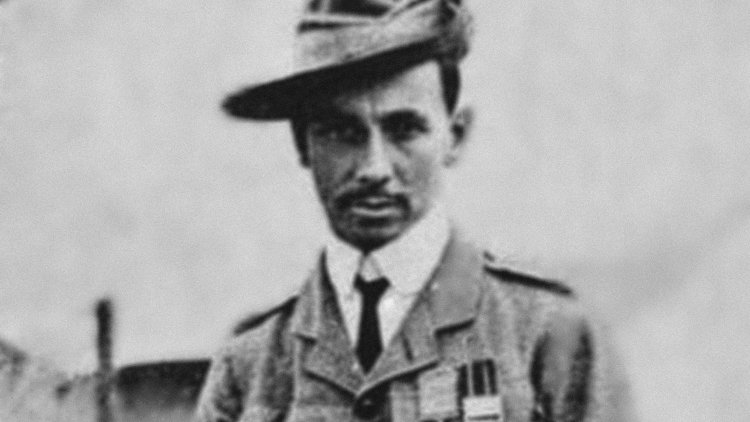
William John English was an Irish-born soldier whose exceptional bravery during the Second Boer War earned him the Victoria Cross (VC), the highest military decoration for gallantry awarded to British and Commonwealth forces. Born on 6 October 1882, he was educated first at Harvey Grammar School in Folkestone and then at Campbell College, Belfast, around 2.5 miles from here. In 1900 he travelled to South Africa, where he joined the Scottish Horse, a yeomanry regiment formed for service in the Boer War. Initially serving in the ranks, he was commissioned as an officer in March 1901.
At only 18 years old, English performed the act of extraordinary courage for which he would receive the VC. On 3 July 1901, at Vlakfontein, he and five men defended the right flank of a British position against a fierce Boer assault. Despite suffering casualties—two killed and two wounded—English held the position largely through his own determination. When ammunition ran low, he crossed roughly 15 yards of open ground under extremely heavy fire, at ranges as close as 20 to 30 yards, to obtain supplies from a neighbouring unit. This feat of fearlessness ensured the position held. He received the VC personally from the Prince of Wales during the Coronation Parade of colonial troops in London on 1 July 1902.
English continued a distinguished military career. He was commissioned into the Royal Army Service Corps in 1906 after service with the 2nd Dragoon Guards and ultimately rose to the rank of Lieutenant Colonel. Remarkably, he saw action in three major conflicts: the Second Boer War, the First World War, and the Second World War. He died on active service with the Royal Ulster Rifles in 1941, suffering a cerebral haemorrhage aboard a ship near Egypt. He is buried in Maala Cemetery in Aden (modern Yemen). His medal group, including the Victoria Cross, was bequeathed to Campbell College, Belfast.