
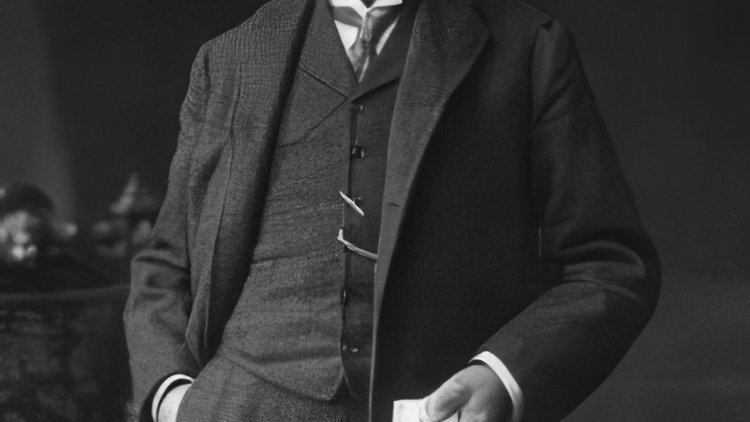
Gustav Wilhelm Wolff was a German-born British shipbuilder, businessman and long-serving politician whose career helped shape Belfast’s industrial and political landscape. Born in Hamburg, he moved to Liverpool in 1849 and later undertook an engineering apprenticeship in Manchester. While working as a draughtsman in Hyde, he was recruited by Edward Harland as a personal assistant in 1857. In 1861 Wolff became Harland’s partner, and together they founded the world-renowned shipbuilding firm Harland and Wolff (H&W).
Wolff played a central managerial and engineering role within the shipyard, helping to expand its capabilities, and through his family and cultural links to the Jewish communities in Hamburg and Britain, he helped attract valuable international business.
His relationship with Albert Ballin of the Hamburg America Line proved particularly important, but it was H&W’s most famous ship – RMS Titanic (1912) – that shaped its fame and reputation. After the firm became a limited company in 1888, Wolff served as a director, though he gradually withdrew from active involvement before officially retiring in 1906.
Beyond shipbuilding, Wolff was active in public service. He was a Belfast Harbour Commissioner between 1887 and 1893 and, like Harland, became a Conservative and Unionist MP. Representing Belfast East from 1892 to 1910, he was first elected in a by-election and thereafter returned unopposed, perhaps because he was a vocal opponent of Irish Home Rule.
A member of the Church of Ireland, Wolff supported charitable institutions, including the Ulster Hospital for Women and Children, and the Orange Order. Unmarried, he spent his later years in London, where he died in 1913. His estate included several charitable bequests, notably to Letitia Alice Walkington, the first woman to earn a law degree in Britain or Ireland.