
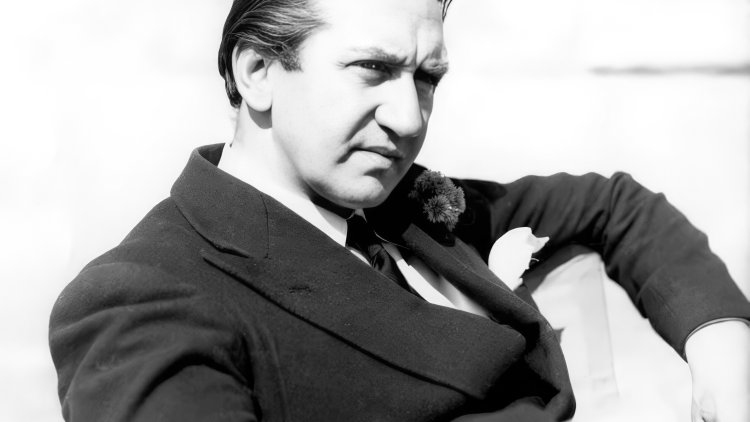
Born to a working class family in Ribble Street, just off the Newtownards Road, Brian Desmond Hurst had shipyard blood running through his veins. His father worked there, helping to build RMS Titanic, and Brian’s brother joined him as soon as he was old enough.
Brian enlisted as a private in the British Army upon the outbreak of World War I in 1914, serving with the 6th Battalion Royal Irish Rifles in the Balkans and Middle East. But it was in the Gallipoli campaign (1915-16) that he experienced the most brutal, devastating action.
Returning from the war, Brian emigrated to Canada in 1920, enrolling in the Toronto College of Art and quickly becoming fascinated by the world of filmmaking.
He learned his craft from one of the Hollywood greats, John Ford, appearing as an extra in a couple of the legend’s films, most notably alongside John Wayne in Hangman’s House (1928).
With a deep knowledge of film direction and set management, Brian returned to the UK in 1933, settling in the upmarket neighbourhood of London’s Belgravia.
The 1950s cemented his reputation as possibly one of Ireland’s greatest ever directors with the iconic Scrooge (1951) starring Alastair Sim and Michael Horden, Tom Brown’s Schooldays and the box-office smash, Malta Story (1953) starring Alec Guinness. In 1952 he worked again with his mentor, John Ford, as an advisor on the world-famous romantic comedy The Quiet Man.
Brian went on to make many more movies during the 1950s and early 1960s, his adaptation of Playboy of the Western World in 1962 being his final film, although he lived for another 24 years until his passing on 26th September 1986. His ashes were scattered on the grave of his older brother and Belfast shipyard worker Robert, in the city’s Dundonald Cemetery.