
By 1941, Belfast was one of the most strategically important cities in the Allied war effort. The Harland and Wolff shipyard, just yards from here, produced over 260 vessels during the war – including aircraft carriers, cruisers, and merchant ships – while also repairing and converting thousands more. Short Brothers and Harland manufactured over 1,500 heavy bombers, principally the Short Stirling, and the city’s engineering works turned out tanks, guns and ammunition. East Belfast, home to much of this vital industry, was squarely in the crosshairs of Germany’s Luftwaffe.
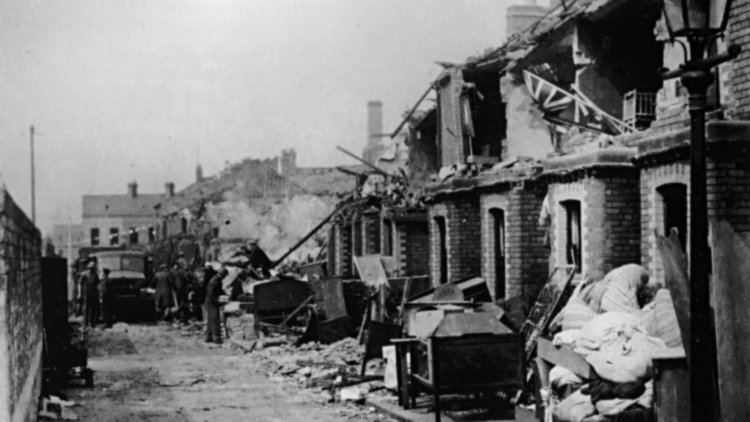
The first raid came on the night of 7th April, a relatively small attack that nonetheless killed thirteen people and served as a grim warning of what was to follow. Eight days later, on 15th April – Easter Tuesday – approximately 200 bombers returned in the deadliest single raid on any United Kingdom city outside London during the entire war. Over 900 people were killed that night, with thousands more injured and entire streets obliterated. Here in east Belfast, bombs aimed at the shipyard fell on the surrounding residential streets, devastating tightly packed working-class communities. Thorndyke Street, Ravenscroft Avenue and the surrounding area suffered catastrophic losses, with families sheltering in public air raid shelters among the victims.
A further fire raid on 4th May 1941 caused widespread destruction, and a final attack followed on 5th May. Across the four raids, over 1,000 people lost their lives, more than 1,500 were seriously injured and some 100,000 were left temporarily homeless – roughly a quarter of the city’s population at the time. Tens of thousands more fled to the surrounding countryside in the largest mass evacuation of any British city during the war.
Yet the people of east Belfast, and the city as a whole, refused to be broken. Though two-thirds of Harland and Wolff’s workshops had been devastated, and full production was not restored until later that year, the resolve of the workforce never wavered. The factories resumed production and the community pulled together in ways that would define this neighbourhood for generations. The Belfast Blitz remains one of the most significant and painful chapters in the city’s history – a reminder of the terrible cost of war and the extraordinary resilience of the people who endured it.